Facebook Ads for Contractors: How to Get Booked Jobs in 2026
By Jason Allee, founder of MarketRev. Last updated November 24, 2026. Disclosure: MarketRev runs Facebook and Instagram ads for service businesses, and this guide uses our own client results as examples.
Facebook ads work for contractors when three things line up: a specific offer homeowners want, real video of your work and crew, and a reply to every lead within minutes. Meta reaches homeowners before they search, so it suits planned, visual jobs. Urgent repairs like leaks and no-heat calls usually belong on Google.
Key takeaways
Facebook and Instagram create demand. Google captures demand that already exists. Most contractors need to know which one their best jobs come from.
Ads that promote housing repairs may have to run in Meta's Housing special ad category, which blocks ZIP code targeting and requires at least a 15-mile radius.
Use the Leads objective with an instant form set to "Higher intent" and two or three qualifying questions.
Phone video of you, your crew and finished jobs usually beats stock footage and polished graphics.
Set your budget from what a booked job is worth, then judge the campaign by cost per booked job, not cost per lead.
Most failed campaigns fail at follow-up. Reply to every lead within minutes, by text and phone.
Do Facebook ads work for contractors?
Yes, for the right jobs. Facebook and Instagram ads reach homeowners in your service area before they start searching, so they work best for planned, visual work: remodels, roofing, landscaping, windows, permanent lighting and similar projects people think about for weeks.
They work poorly for emergencies. Someone with a burst pipe searches Google and calls the first plumber who answers. That's why many contractors who say "Facebook ads don't work" were advertising the wrong job on the wrong channel, or never followed up with the leads they got.
Facebook ads vs Google ads for contractors
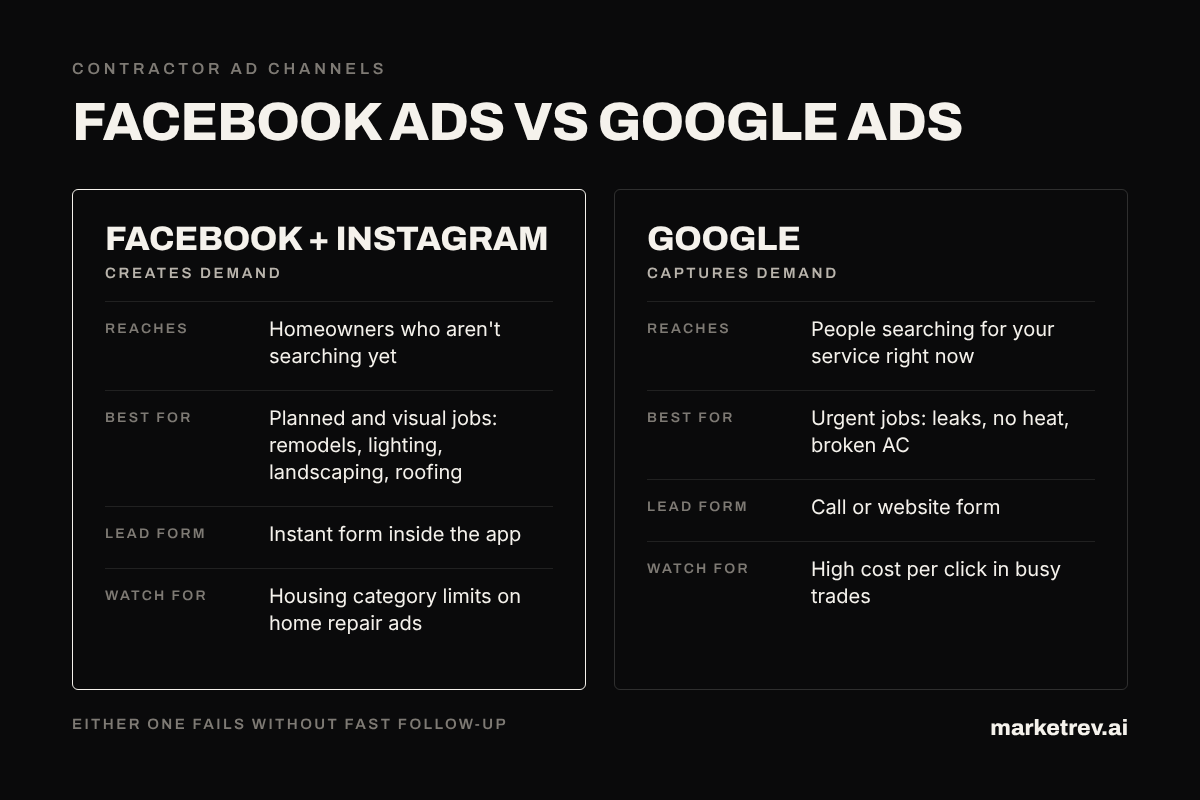
Facebook creates demand and Google captures it. Use Facebook to put a planned project in front of homeowners who haven't started looking, and Google to answer people already searching for your service.
Facebook and Instagram ads | Google Ads | |
|---|---|---|
Who you reach | Homeowners in your area who aren't searching yet | People searching for your service right now |
Best jobs | Planned and visual: remodels, roofing, landscaping, lighting | Urgent: leaks, no heat, broken AC, storm damage |
How leads arrive | Instant form inside the app, or a message | Phone call or website form |
What makes it work | A clear offer and real video | Strong keywords, reviews and a fast landing page |
Main limit | Housing category rules on home repair ads | High cost per click in busy trades |
Check the Housing special ad category first
Meta's Housing special ad category covers more than real estate. Its definition includes "housing repairs, home equity or appraisal services," so many home repair and improvement ads must be run under it.
When an ad runs in the Housing category, Meta limits the targeting:
Location must cover at least a 15-mile radius, and you can't target by ZIP code.
Age is fixed at 18 to 65+, and you can't target by gender.
Lookalike audiences aren't available, and some detailed targeting options are removed.
Action: Decide before you build the campaign whether your ad promotes a housing repair. If it does, select the Housing category in Ads Manager. Ads that should be in the category but aren't can be rejected. Plan your service area around the 15-mile minimum.
How to set up a Facebook ad campaign for a contracting business
Most contractor campaigns need one objective, one offer, one form and one service area. Keep it that simple until it produces booked jobs.
Pick one job to advertise. Choose your most profitable planned service, not your whole list.
Write one clear offer. Example: "Free roof inspection with photos of every problem we find, this month only." Specific beats clever.
Choose the Leads objective. In Ads Manager, create a campaign with the Leads objective and an instant form.
Set the form to "Higher intent." This adds a review step before the form submits, which filters out accidental taps. Add two or three questions that qualify the job, such as the type of project and the timeline.
Set your location. Draw the area you actually serve. If the Housing category applies, it must be at least a 15-mile radius.
Load two or three videos. Different hooks, same offer. Let Meta show the best one.
Connect the form to your CRM. Every lead should text you and the homeowner the moment it arrives.
What ad creative works for contractors?
Real phone video of you, your crew and finished jobs. Homeowners are letting you into their house, so they want to see who shows up.
Owner to camera: 20 to 40 seconds on the problem you fix and the offer.
Before and after: the same angle, shot on the same phone.
Crew at work: a short clip of the team on a real job.
Customer reaction: a happy homeowner, filmed with permission.
Film vertically, add captions (many people watch with the sound off), and say the offer in the first three seconds. At MarketRev, clients film the source footage and we coach what to shoot, then edit it into ads. A business that won't film is a poor fit for this kind of campaign.
How much should a contractor spend on Facebook ads?
Set your budget from what a booked job is worth to you, not from a round number. You can't know your cost per lead until you test, so plan a 30-day test you can afford to finish.
A simple way to set it, using example numbers:
Average job value: $8,000.
What you'll spend to win one job: 10%, or $800.
Jobs you want from the test: 3.
Test budget: 3 × $800 = $2,400 over 30 days, or about $80 a day.
Then judge the result by cost per booked job, not cost per lead. A $90 lead that books a $8,000 job beats a $15 lead that never answers the phone.
Is $10 a day enough? You can start there, but it buys very few leads in most trades and makes the test slow to read. Ad spend is paid to Meta, and any agency fee is separate.
Why most contractor Facebook ads fail: follow-up
Most contractor campaigns don't fail at the ad. They fail after the lead arrives. A homeowner who fills out a form at 7 p.m. and hears nothing until the next afternoon has often already called someone else.
Harvard Business Review research found that firms contacting leads within an hour were nearly seven times as likely to qualify them as firms that waited even an hour longer. For a contractor, that means:
An automatic text the moment the form arrives.
A call within minutes during business hours.
Follow-up texts for several days until the homeowner books or says no.
Missed calls texted back automatically, or answered by an AI receptionist after hours.
Real results from contractor Facebook ads
Two MarketRev clients show what happens when the offer, video and follow-up work together. Both results are client-reported.
WellCraft Drilling closed over $40,000 in jobs in its first 30 days, from $600 in ad spend.
KnightLights, a permanent lighting company, closed $13,000 in its first four days after moving from door knocking to Meta ads with automated follow-up.
These are our own client results, not averages. Results depend on your offer, area, season and how fast you follow up, and no agency can honestly promise a number.
Facebook ads by trade
What to advertise depends on your trade. Lead with the planned job, not the emergency.
Roofers: free inspections with photos, and replacements before the wet season. Storm repair is usually a Google job.
Plumbers: planned work like water heater replacements, repiping and remodel plumbing. Emergency calls belong on Google.
Landscapers: design and install projects before peak season, shown with before and after video.
HVAC: system replacements and maintenance plans ahead of summer and winter.
Remodelers: kitchen and bath projects, with walkthrough video of finished work.
Frequently asked questions
Do Facebook ads work for contractors?
Yes, for planned, visual jobs like remodels, roofing, landscaping and lighting. They work poorly for emergencies, which people search for on Google. Results depend on a clear offer, real video and replying to every lead within minutes.
How much should a contractor spend on Facebook ads?
Start from what a booked job is worth and how much you'll spend to win one, then plan a 30-day test you can afford to finish. Judge it by cost per booked job, not cost per lead. Ad spend is paid to Meta, separate from any agency fee.
Is $10 a day enough for Facebook ads?
You can start at $10 a day, but in most trades it buys very few leads and makes a test slow to read. Set the budget from your job value and the number of jobs you want, not a round number.
Are Facebook ads or Google ads better for contractors?
It depends on the job. Facebook ads reach homeowners before they search, so they suit planned projects. Google Ads reach people searching right now, so they suit urgent repairs. Many contractors use both.
Do contractor ads have to use Meta's Housing special ad category?
Ads that promote housing repairs may have to. Meta's Housing category includes housing repairs, home equity and appraisal services. It requires at least a 15-mile radius, blocks ZIP code targeting and removes lookalike audiences.
Should I use Facebook instant forms or send people to my website?
Instant forms usually bring more leads because people never leave the app. Set the form to "Higher intent" and add qualifying questions to keep quality up. Send people to your website when it books appointments directly and loads fast on a phone.
Want someone to run it for you?
MarketRev's Meta Lead Engine plans the offer, coaches your filming, edits the video and runs the campaign, from $2,000 a month plus ad spend paid to Meta, month to month. See MarketRev plans, or compare options in our list of the best marketing agencies for home service businesses.
About the author
Jason Allee is the founder of MarketRev. He spent nearly 30 years building and running businesses before starting MarketRev in St. George, Utah, with his sons Micah and Chase. MarketRev builds and runs marketing for service businesses, including the client results cited above.
Sources
Oldroyd, McElheran and Elkington, "The Short Life of Online Sales Leads," Harvard Business Review, 2011
Meta for Developers, "Special Ad Categories"
Jon Loomer, "Special Ad Categories: A Guide for Meta Ads"
Jon Loomer, "A Guide to Instant Forms"


